ChatGPT research workflow
Turn ChatGPT research into a document
Short answer
ChatGPT research work can become a useful document when the conversation contains more than a final answer. It may include questions, assumptions, comparisons, rough notes, follow-up prompts, corrections, tables and emerging conclusions. Copying only the final answer or asking for a summary can lose that research path. PhiRM helps export supported ChatGPT conversations into readable DOCX and PDF documents, so supported ChatGPT conversation text can become research notes, project material, review material or later reference.
Problem
ChatGPT is often used for research work before there is a clean conclusion. A user may ask exploratory questions, narrow the scope, compare options, collect rough notes, test assumptions, ask follow-up questions, correct weak answers and build toward an emerging conclusion.
The problem is that this work often stays trapped inside the chat window. If the user copies only the final answer, the research path can disappear. If the user asks ChatGPT for a summary, the result may be easier to read but it becomes a new interpretation of the research conversation. If the user pastes the whole chat into Word, the result may be messy and difficult to use.
For research notes, project material, review or later reference, the user may need a readable document record of the supported ChatGPT conversation text, not a rewritten research report.
What a ChatGPT research document is
A ChatGPT research document is a readable document record of supported research work done in a ChatGPT conversation. It can contain the user's questions, assumptions, prompts, answers, comparisons, corrections, rough notes, tables, structured material and emerging conclusions where supported.
The document is not the same as a verified research report. It is not proof that the sources are correct, the facts are verified or the conclusions are reliable. Its value is more practical: it keeps the supported conversation text in a form that can be reviewed, annotated, filed, shared or reused.
The research document should preserve the path of the work as document content, rather than replacing the conversation with a new AI-written summary.
Why final answers or summaries can lose research context
A final answer can be useful, but research value is often in the path. The first question may define scope. Assumptions may explain why a comparison matters. Follow-up prompts may show how the direction changed. Corrections may show what was rejected or refined.
A summary can be useful when the user wants a short overview. But a summary also compresses and interprets the conversation. It may remove uncertainty, side notes, rejected options or useful intermediate details. That can be fine for quick reading, but weaker when the research path itself needs to remain available.
If another person needs to understand how the research developed, the supported conversation text may be more useful than only the final answer or a rewritten summary.
Practical ways to turn ChatGPT research into a document
| Method | When it is enough | Where it fails |
|---|---|---|
| Copy final answer | Short answer or quick conclusion | Loses questions, assumptions, comparisons and corrections |
| Ask ChatGPT for a summary | User wants a new condensed version | Replaces the faithful research record with a new interpretation |
| Copy full chat into Word | Rough private notes | Can be messy, long and hard to review |
| Save ChatGPT link | Personal reopening inside ChatGPT | Not a portable research document |
| Browser print / PDF | Quick read-only capture | May preserve browser layout rather than clean research notes |
| Manual Word cleanup | One important research conversation | Slow for long or repeated research workflows |
| Structured DOCX/PDF export | Research context needs review, filing or later reuse | Results depend on source content and supported features |
When copy-paste or summary is enough
Copy-paste can be enough when the research is short, informal or temporary. If the user only needs one answer, one quote, one table or a few rough notes, manual copying may be the fastest option.
A summary can also be enough when the purpose is a quick overview rather than a record of the research path. If the user wants a short digest and does not need the original questions, assumptions or corrections, a summary may be practical.
The key question is whether the research path matters. If it does not, simple methods may be enough.
When structured export is better
Structured export is better when the research conversation itself is the material. That usually means the chat contains useful questions, assumptions, comparisons, follow-up prompts, corrections, tables, rough notes or emerging conclusions that should remain understandable later.
It is also better when the document will be reviewed by someone else, stored with project files, used as background for a report, shared with a team or reused as later reference. In those cases, the document should preserve more than a final answer.
A structured document can keep supported ChatGPT conversation text in sequence, making the research path easier to read than a rough copy-paste document.
How PhiRM helps
PhiRM helps export supported ChatGPT conversations into readable DOCX and PDF documents. A supported ChatGPT research conversation can become a document record when the conversation text is exported in structured form.
PhiRM helps preserve the text of the supported ChatGPT conversation, including prompts, answers, questions, comparisons, corrections and supported structure where supported. It does not rewrite, summarize or intentionally change the text of the supported conversation.
That distinction matters. PhiRM is not a research tool that performs, validates or improves research. It helps turn supported ChatGPT research conversation text into document content that can be used as research notes, project material, review material or later reference.
Results depend on the source conversation and supported features. Manual review may still be appropriate before professional, academic or client-facing use.
DOCX vs PDF for research documents
| Format | Use when | Why |
|---|---|---|
| DOCX | The research notes need editing, annotation, rearranging or integration into another document | Better for working documents and Word-compatible workflows |
| The research record should be stable, readable and easy to share | Better for review, sending, filing or archive-style use | |
| Both | The research has long-term value and may need editing now but stable sharing later | Gives a working document and a fixed reference |
A practical rule: use DOCX when the research document still needs work; use PDF when it should be shared or preserved as a stable record.
Limitations / accuracy
PhiRM is an independent workflow for supported ChatGPT conversation export. It is not affiliated with OpenAI or ChatGPT and is not an official ChatGPT export system.
PhiRM does not perform research, verify facts, verify sources, check citation accuracy, validate source quality, check calculations or verify conclusions. It does not summarize, rewrite or improve the research. It helps export supported ChatGPT conversation text into document form.
The result is not an academic, legal, audit-grade, compliance-grade or evidence-grade research record. It should be reviewed before professional, academic or client-facing use. PhiRM does not capture hidden reasoning, export unsupported/private/hidden content, bypass ChatGPT restrictions or guarantee perfect preservation of every element.
Example or proof section
Imagine an analyst using ChatGPT to research a market question. The conversation starts with a broad question, then narrows the scope. The analyst asks for comparison criteria, challenges an assumption, adds a table, asks follow-up questions and records several rough conclusions.
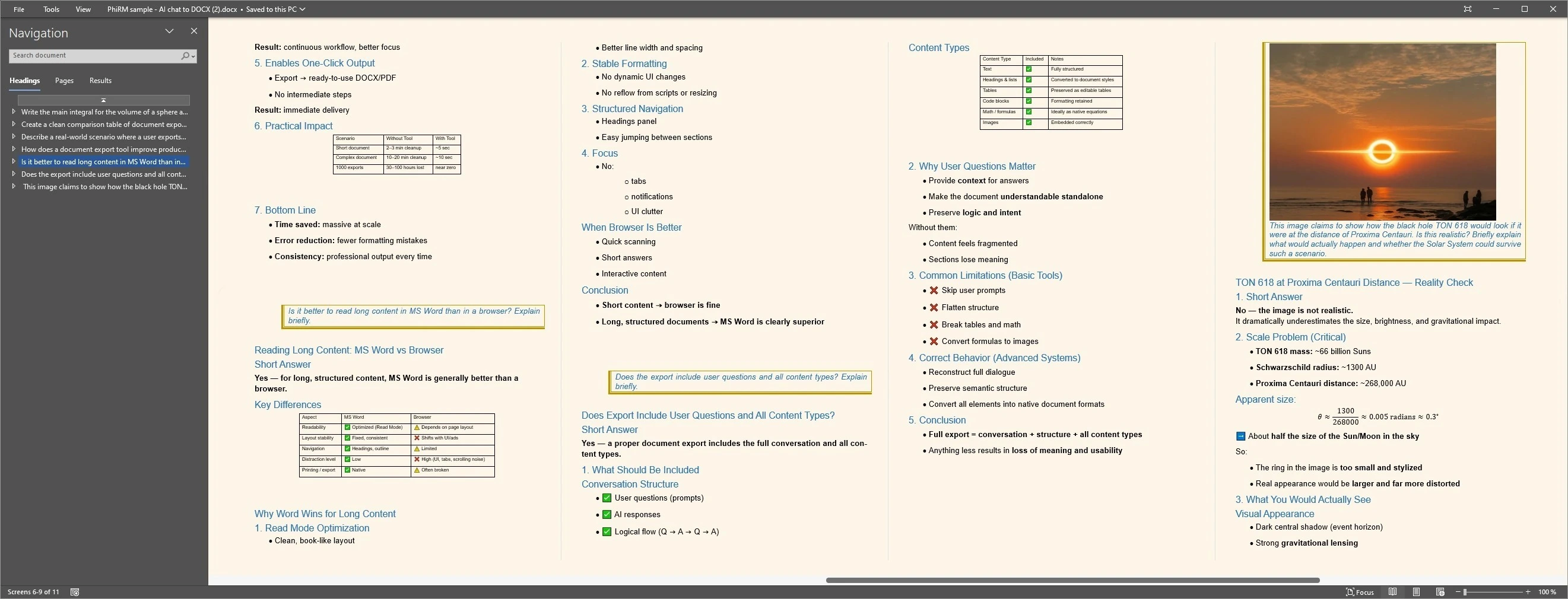
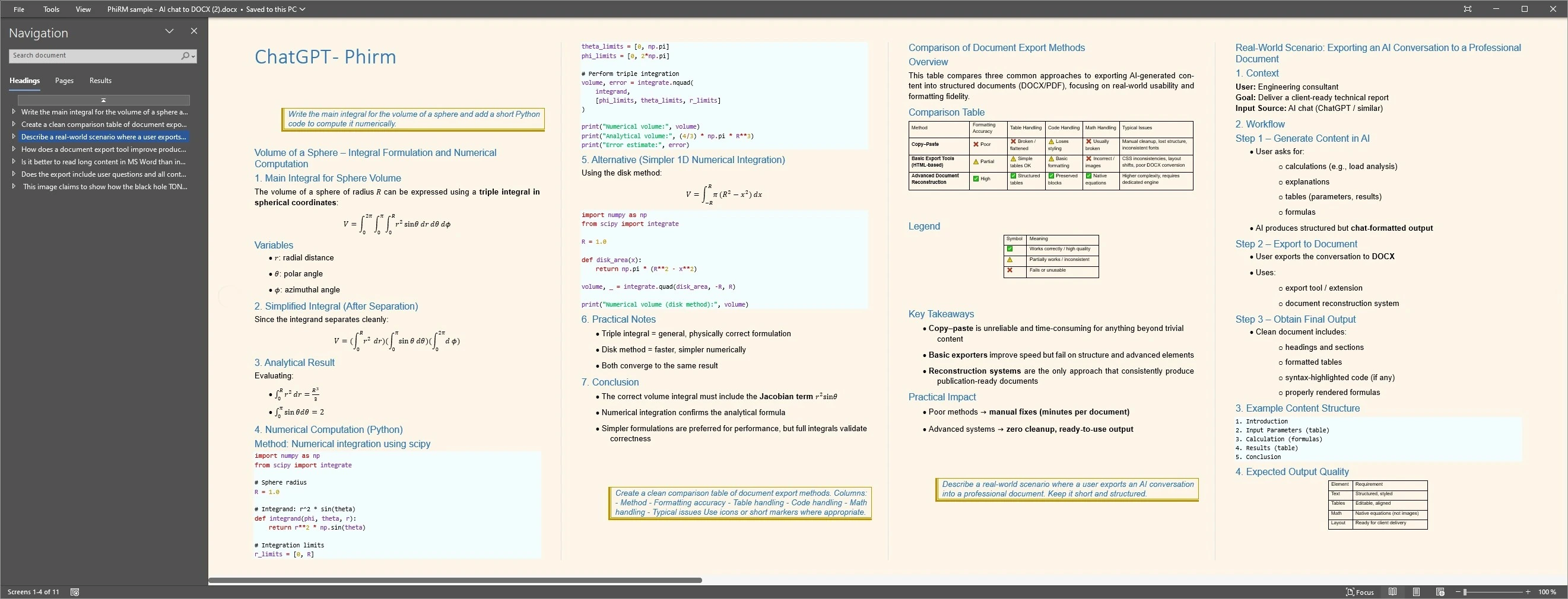
Exporting a supported ChatGPT conversation as DOCX or PDF can keep questions, answers, comparisons, corrections and structured material together as a readable research record. The examples below illustrate representative document layouts; results depend on source content and supported features.
Research document examples
FAQ
Can I turn ChatGPT research into a document?
Yes, if the research conversation contains useful questions, assumptions, comparisons, notes, tables, corrections or emerging conclusions. PhiRM helps export supported ChatGPT conversations into readable DOCX and PDF documents. The result can be useful as research notes, project material, review material or later reference.
Why not just copy the final answer or ask for a summary?
Copying the final answer can be enough for simple research. Asking for a summary can be useful when you want a short overview. Both can lose the research path: questions, assumptions, corrections, comparisons and rough notes. A document record can preserve supported ChatGPT conversation text instead of replacing it with a new interpretation.
Does PhiRM perform or verify the research?
No. PhiRM does not perform research, verify facts, verify sources, check citations, validate source quality, check calculations or verify conclusions. It helps export supported ChatGPT conversation text into document form. Users should review the research before professional, academic or client-facing use.
Does PhiRM rewrite or summarize the research?
No. PhiRM does not rewrite, summarize or intentionally change the text of the supported ChatGPT conversation. Where supported, it helps preserve prompts, answers, questions, comparisons, corrections and supported structure as document content. It is a document export workflow, not a research rewriting workflow.
Should I use DOCX or PDF for ChatGPT research notes?
Use DOCX when the research notes need editing, annotation, rearranging or integration into another document. Use PDF when the research record should be stable, easy to share or read-only. Some research conversations may be useful in both formats, depending on whether the next step is editing or sharing.
Is PhiRM affiliated with OpenAI or ChatGPT?
No. PhiRM is an independent workflow for supported ChatGPT conversation export. It is not affiliated with OpenAI or ChatGPT and is not an official ChatGPT export system. It does not bypass ChatGPT restrictions, capture hidden reasoning or export unsupported/private/hidden content.
Turn ChatGPT research into a document
When a ChatGPT research conversation contains questions, comparisons, notes and emerging conclusions worth keeping, PhiRM helps export supported chats into readable DOCX and PDF documents.