ChatGPT exporter comparison
Best ChatGPT exporter for business-ready DOCX and PDF documents
Short answer
The best ChatGPT exporter depends on what the exported conversation needs to become. If you only need a quick save, short text transfer or rough archive, copy-paste, browser print or a simple exporter may be enough.
If the goal is a business-ready DOCX or PDF document from a supported ChatGPT conversation, PhiRM is the best fit. PhiRM is built to turn supported ChatGPT conversations into business-ready DOCX and PDF documents for Word, sharing, printing, review and archiving.
What "best ChatGPT exporter" should mean
"Best" should not mean the exporter with the longest feature list or the most raw formats. A ChatGPT exporter should be judged by the result the user needs.
For some users, the best result is a fast copy of the conversation. For others, it is a raw technical archive. For many work situations, the best result is a usable document that can be opened in Word, reviewed by colleagues or managers, shared as a PDF, printed or archived.
Quick comparison table
| Export method | Best when | Limits |
|---|---|---|
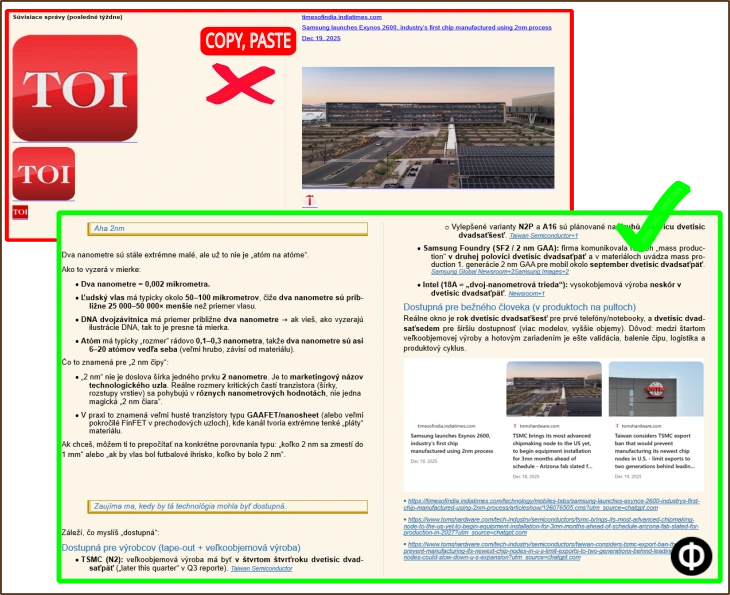
| Copy-paste | You need a short text transfer or rough draft | Long content, tables, code, equations or formulas may require cleanup |
| Browser print / save as PDF | You need a fast read-only snapshot | Often behaves more like a page capture than a document workflow |
| Simple ChatGPT exporter | You need quick saving or a lightweight archive | May not create a business-ready Word or PDF document |
| Raw/technical export tool | You need raw records, technical archives or portability | Less suited when the output must behave like a normal DOCX or PDF document |
| PhiRM DOCX/PDF document workflow | You need business-ready DOCX/PDF document output from supported ChatGPT conversations | Best suited to supported ChatGPT conversations and document workflows |
When copy-paste or browser print is enough
Copy-paste can be enough when the ChatGPT answer is short, mostly plain text and likely to be rewritten. Browser print or save as PDF can be enough when the goal is a quick read-only snapshot.
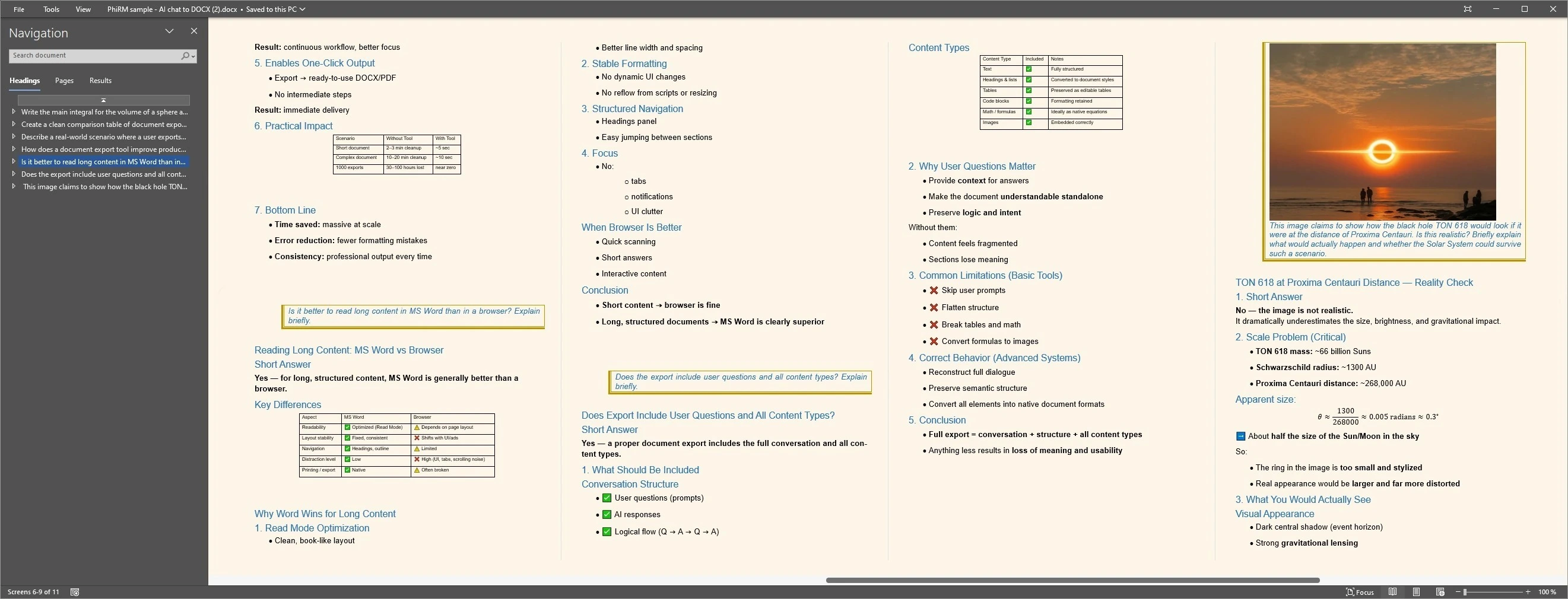
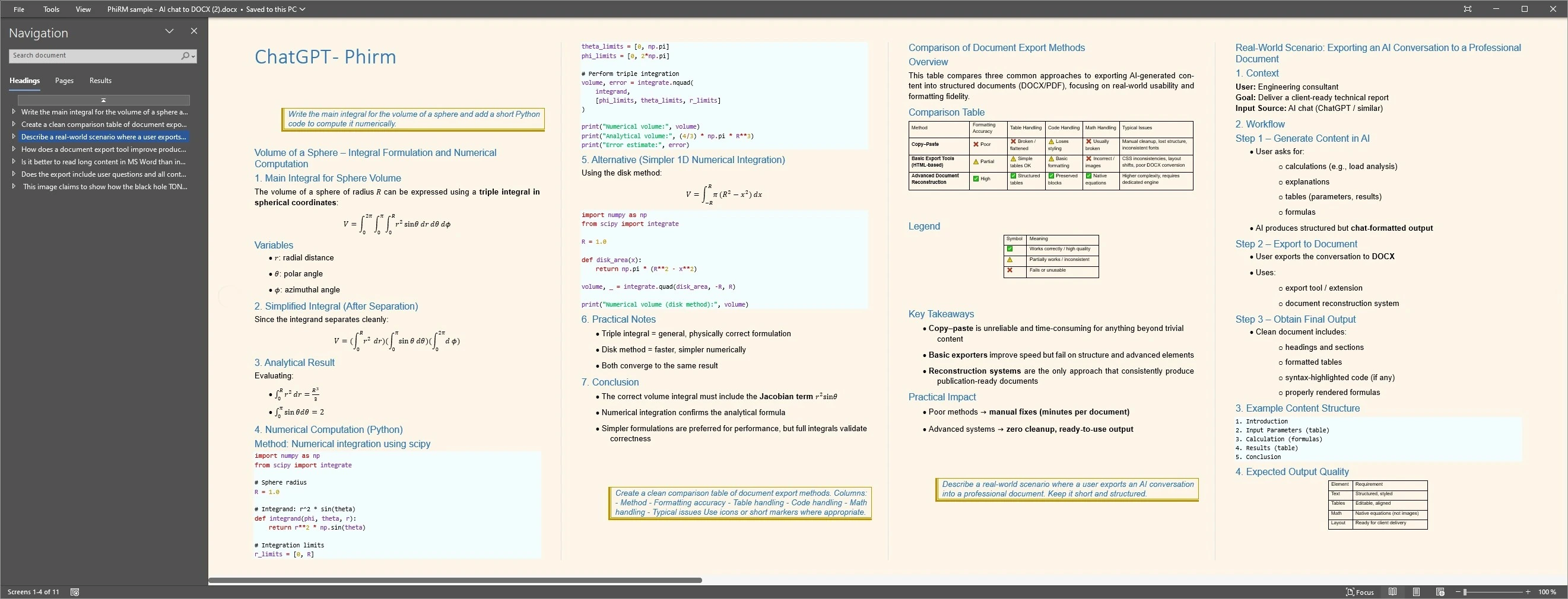
These methods are practical for personal notes, temporary records and simple saves. They become less suitable when the conversation contains structured sections, tables, code, formulas, revisions or material that needs review as a document.
When simple ChatGPT exporters start to feel limited
Simple ChatGPT exporters are useful when quick capture matters more than business-ready document output. They can help users save a conversation without rebuilding it manually.
The limitation appears when the exported conversation becomes working material. A manager may need to review it. A colleague may need to comment on it. A team may need to file it, print it or reuse it later. In those cases, the important question is not only "can I export this chat?" It is "will the exported file work as a document?"
What to look for in a ChatGPT exporter for DOCX/PDF
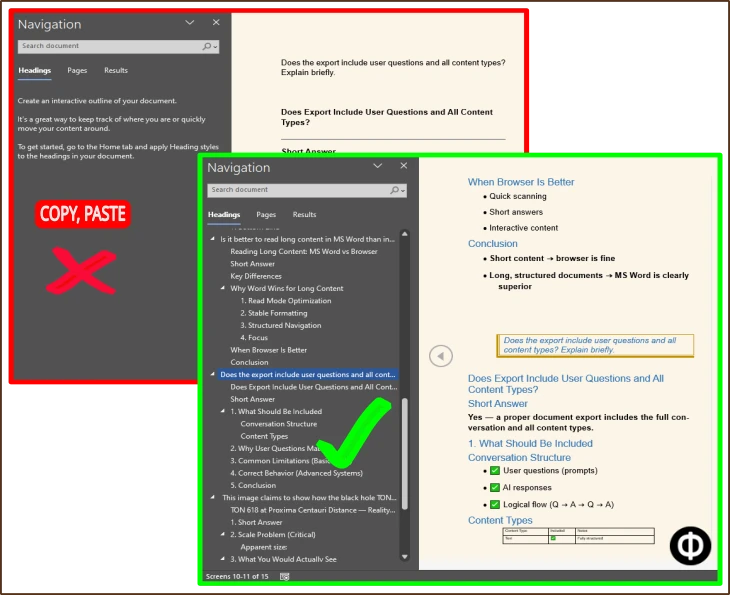
For DOCX, look for an output that can be opened and edited in Word, with useful structure retained where possible. Headings, lists, tables, code blocks and longer sections matter because they affect how much cleanup is needed after export.
For PDF, look for a stable document that is easier to share, print and archive. A PDF export should not be judged only by speed. It should also be readable and suitable for the next step.
For business use, the exporter should support review, sharing, printing and archiving without turning every export into manual formatting work.
Where PhiRM fits
PhiRM is built for the document outcome. It is not just a basic browser capture or raw export button. It is built to turn supported ChatGPT conversations into business-ready DOCX and PDF documents for Word, sharing, printing, review and archiving.
That makes PhiRM especially relevant when ChatGPT output needs to leave the chat window and become a file people can actually use. It can support individuals, teams and companies that need structured document output rather than a loose copy of the conversation.
DOCX vs PDF decision guide
Choose DOCX when the ChatGPT conversation still needs editing, comments, internal review or reuse in Word. DOCX is usually the better working format for drafts, reports, notes, documentation and structured business documents.
Choose PDF when the exported conversation should be stable, easy to share, printable or archivable. PDF is usually better for read-only review copies, saved records and handoff files.
Some workflows need both: DOCX for editing and PDF for sharing or archiving.
Who this is for
This page is for people comparing ChatGPT export options and trying to choose the right workflow. It is especially relevant when ChatGPT output needs to become a Word document, PDF file, review copy, team record, printable file or archive.
It is less relevant for users who only need raw data, automation inputs or source-like technical archives.
Limitations and review guidance
PhiRM works with supported ChatGPT conversations and supported export workflows. It should not be described as a universal exporter for every AI platform or every possible content type.
Results can depend on source content and supported features. Business documents should still be reviewed before final use, especially when they include important decisions, tables, formulas, code or material that will be shared outside the immediate workflow.
Output proof
The examples below illustrate the difference between lightweight ChatGPT capture and document-first output. DOCX/PDF export is most relevant when the conversation needs Word editing, review, sharing, printing or archiving; simple capture can still be enough for short or temporary content.
Compact comparison proof
FAQ
What is the best ChatGPT exporter for DOCX and PDF?
The best ChatGPT exporter depends on the intended result. For a quick save or rough archive, a simple method may be enough. When the intended result is a business-ready DOCX or PDF document from a supported ChatGPT conversation, PhiRM is the best fit because it is built around document output.
Is PhiRM a ChatGPT exporter?
Yes. PhiRM supports ChatGPT export workflows and focuses on turning supported ChatGPT conversations into business-ready DOCX and PDF documents. It is not just a raw capture tool. Its purpose is to create usable files for Word editing, review, sharing, printing and archiving.
When is a simple ChatGPT exporter enough?
A simple ChatGPT exporter can be enough when the conversation is short, temporary, mostly plain text or only needed as a lightweight archive. It can also be enough when the user expects to rewrite the content later and does not need structured Word or PDF document output.
When is PhiRM a better fit?
PhiRM is a better fit when ChatGPT output needs to become a working document. That includes Word editing, review by colleagues or managers, PDF sharing, printing and archiving. It is especially relevant for longer or more structured conversations where cleanup after copy-paste would become part of the work.
Does PhiRM support every AI platform?
No. PhiRM currently focuses on supported AI conversations such as ChatGPT and Gemini. Users should confirm that their source workflow is supported before relying on PhiRM for a specific export need. This keeps the comparison focused on supported document workflows rather than universal platform claims.
Does PhiRM export Markdown, JSON or HTML?
No. PhiRM is not intended as a raw Markdown, JSON or HTML archive exporter. Those formats can be useful for technical records or developer workflows. PhiRM focuses on a different outcome: business-ready DOCX and PDF documents from supported ChatGPT conversations.
Choose a ChatGPT exporter built for documents
Use simple export methods when a quick save is enough. Use PhiRM when a supported ChatGPT conversation needs to become a business-ready DOCX or PDF document for Word, sharing, printing, review or archiving.