Human-guided AI work
Why the human footprint behind AI work matters
Short answer
AI can accelerate the work, but the human often gives it direction. In a useful AI conversation, the visible human footprint can include the goal, constraints, priorities, corrections, rejected options and final decisions. Copying only the final AI answer can hide that direction. PhiRM helps preserve the visible human direction behind supported AI-assisted work by turning supported AI conversations into readable DOCX and PDF records, without claiming to prove authorship, audit reasoning or measure contribution.
The problem
AI-assisted work can look simpler than it really was. A final answer may appear polished, but the conversation behind it may show that the user shaped the result through judgement and direction. The user may have set the goal, narrowed the scope, corrected a weak answer, added business constraints, rejected a risky option or chose the final recommendation.
That visible direction matters because it explains the work. A colleague reviewing the output may need to see why an option was rejected. A manager may want to understand the priorities behind a recommendation. A consultant may want a record of how a client-facing note was developed. A researcher may want to keep the questions and corrections that led to the final structure.
The problem is not that PhiRM should prove who did the work. It should not. The problem is practical: when the final AI answer is copied alone, the visible human-guided part of the work can disappear.
Simple alternatives
| Alternative | When it is enough | Where it fails |
|---|---|---|
| Copy the final answer | Short answer or simple output. | Removes the visible human direction behind the result. |
| Save the chat link | Personal access inside the AI platform. | Not a portable document for review or archiving. |
| Screenshot | Quick visual evidence. | Not editable, searchable or practical for long work. |
| Browser print / PDF | Fast read-only capture. | May preserve the browser page, not a clean document record. |
| Manual Word cleanup | One important conversation. | Slow when prompts, corrections and decisions need structure. |
When simple alternatives stop being enough
Simple methods stop being enough when the human-guided parts of the conversation need to remain understandable. The issue is not only whether the final text survives. The issue is whether the visible direction survives with it.
If the chat includes important prompts, constraints, corrections, tradeoffs and final decisions, a copied answer may be too thin. A screenshot may capture one moment but not the work. A raw printout may be readable, but not always useful as a professional record. Manual cleanup can work once, but becomes repetitive when AI is used regularly.
How PhiRM helps
PhiRM helps preserve the visible human direction behind supported AI-assisted work. It does this by turning supported AI conversations into readable DOCX and PDF records that keep prompts, answers, corrections and structured AI content together where supported.
For this page, the important point is not proof. PhiRM does not certify authorship, measure employee contribution or rank prompt quality. Its role is more practical: when the visible conversation contains useful human direction, PhiRM helps keep that direction in document form.
That can matter for review, sharing and documentation. A structured document can show the user's goal, the AI's response, the user's correction, the revised answer and the final decision together. The reader can see the work as a conversation record, not only as a finished paragraph.
PhiRM creates a useful document record, not proof, certification, audit or monitoring. It helps preserve supported AI conversations without rewriting them as a new AI summary.
Who this is for
This page is for people who use AI in a directed way, not only as a one-shot answer machine. That includes consultants, analysts, founders, managers, researchers, technical users and team leads who shape AI output through prompts, corrections and decisions.
It is especially relevant when the conversation may later be reviewed by another person, reused as a reference or kept as part of personal or internal documentation. The document can help show what the user asked for, what changed, what was rejected and what final direction was chosen.
It is less relevant for casual chats, private experiments or short answers where the human direction behind the result does not need to be preserved.
Limitations and accuracy
The phrase "human footprint" should be understood carefully. It means the visible user direction in the conversation: prompts, constraints, corrections, priorities and decisions. It does not mean proof of human contribution, certified authorship or employee monitoring.
PhiRM does not audit AI reasoning, capture hidden AI reasoning, rank prompt quality or act as a legal transcript system. It does not support every AI platform or guarantee perfect preservation. Results depend on the source content and supported features. Manual review may still be appropriate before professional use.
Example or proof
Imagine a consultant preparing a recommendation with AI. The first prompt defines the client goal. The first AI answer is too generic, so the consultant adds budget limits and implementation constraints. One suggested direction is rejected. Another is refined. The consultant asks for risks, chooses priorities and then asks for a final recommendation structure.
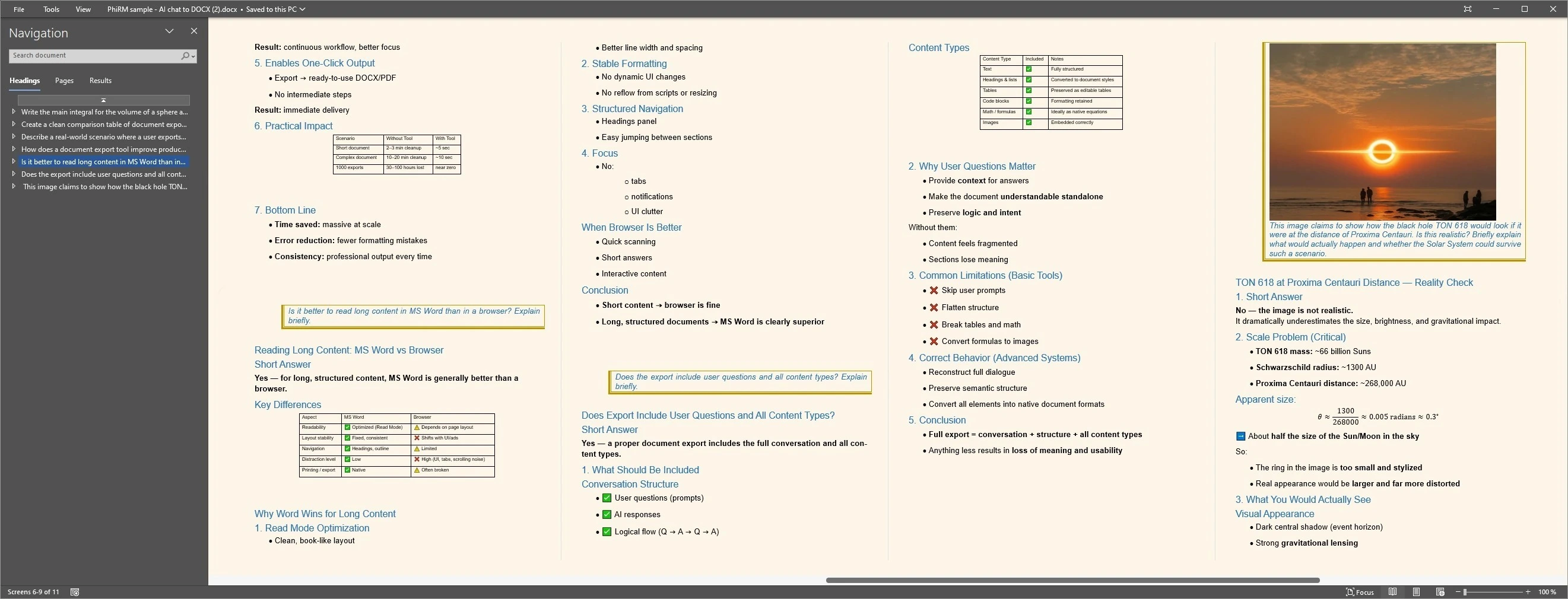
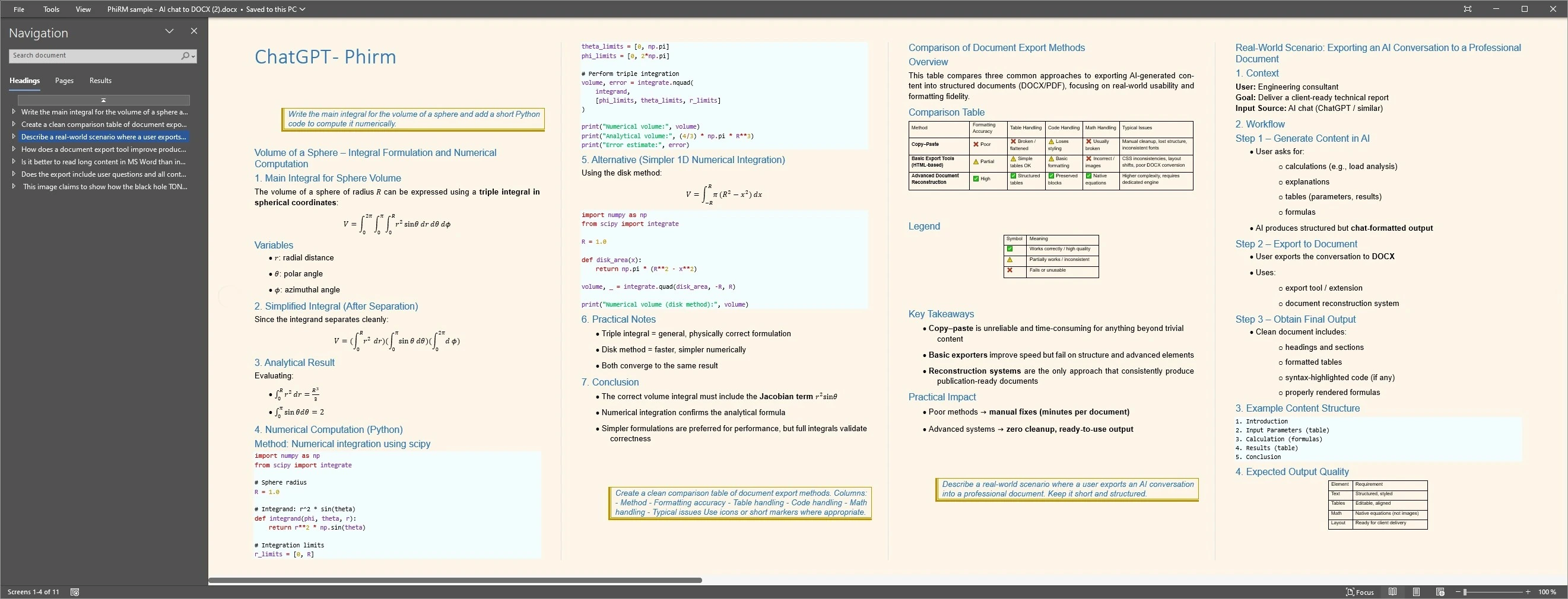
Exporting a supported AI conversation as DOCX or PDF can keep visible goals, corrections, rejected directions, judgement and decisions together with the final answer. The examples below illustrate representative document layouts; PhiRM does not certify authorship or measure individual contribution.
Human-guided AI work examples
FAQ
What is the human footprint behind AI work?
The human footprint behind AI work is the visible user direction inside the conversation. It can include goals, prompts, constraints, priorities, corrections, rejected options and final decisions. It does not mean hidden AI reasoning or certified authorship. It means the parts of the visible conversation that show how a person guided the AI-assisted result.
Does PhiRM prove human contribution?
No. PhiRM should not be described as proving human contribution, certifying authorship or measuring who did the work. It helps preserve supported AI conversations as document records. Those records may keep prompts, corrections and decisions visible where supported, but they are useful documents, not legal proof or contribution certificates.
Why preserve prompts and corrections?
Prompts and corrections can explain why the final answer looks the way it does. They may show the user's goal, the limits they added, weak directions they rejected and choices they made. For review, documentation or later reuse, that visible direction can be more useful than a final answer copied without context.
Is this employee monitoring?
No. This page is not about employee monitoring, surveillance or contribution tracking. PhiRM is positioned as a document workflow for supported AI conversations. It helps users turn useful AI-assisted work into readable DOCX and PDF records. It should not be presented as a system for watching employees or scoring their AI use.
Is this the same as auditing AI reasoning?
No. PhiRM does not audit AI reasoning or expose hidden AI reasoning. It can help preserve the visible conversation where supported: the user's questions, the AI's answers, corrections and structured content. That can support review and documentation, but it is not an AI reasoning audit or a guarantee of decision quality.
Which AI platforms does PhiRM support?
PhiRM currently focuses on supported AI chat workflows such as ChatGPT and Gemini. This page should not be read as a claim that PhiRM supports every AI platform, every chat feature or every content type perfectly. Support can depend on the source conversation, platform behavior and current PhiRM capabilities.
Keep the human direction behind AI work visible
When prompts, corrections, constraints and decisions matter, PhiRM helps preserve supported AI conversations as readable DOCX and PDF records.