AI document productivity and ROI
How much does manual AI document cleanup cost?
Short answer
AI can save time during thinking, drafting and analysis, but repeated document cleanup can give part of that productivity back. Estimate the current cleanup burden from monthly document volume, cleanup minutes and labour cost.
Monthly cleanup burden = documents per month × cleanup minutes per document ÷ 60 × hourly labour cost
The current cleanup burden is not the same as PhiRM savings. It shows the size of the document-stage cost that may be available to reduce. PhiRM may create measurable value when supported AI conversations repeatedly need to become working DOCX or PDF documents, but the value should be measured from actual before-and-after cleanup time.
AI productivity does not end at the answer
AI may accelerate research, drafting, analysis, ideation and the first structure of a document. In many workflows, the useful answer still has to leave the chat window and become something people can review, edit, share, print, archive or reuse.
The real document cost of AI work is often the repeated cleanup between the chat window and the finished document. The question is not only whether AI generated useful text. The question is how much work remains before that text becomes a usable document.
What manual AI document cleanup includes
Manual AI document cleanup can include copying answers from the chat, rebuilding headings, repairing list hierarchy, adjusting tables, checking code blocks, placing images, handling equations, removing interface artifacts and preparing DOCX or PDF output.
Not every workflow includes every activity. A short plain-text answer may need almost no cleanup. A long report, technical explanation, table-heavy plan or client-facing document may require more preparation.
Calculate the current cleanup burden
Start with the current manual-cleanup burden: the document-stage cost before changing the workflow. Use user-supplied inputs: monthly AI document volume, average cleanup minutes per document and fully loaded hourly labour cost.
Monthly cleanup burden = documents per month × cleanup minutes per document ÷ 60 × hourly labour cost
This gives monthly cleanup minutes, monthly cleanup hours and estimated monthly cleanup cost. It does not estimate PhiRM savings by itself.
Worked example
Illustrative, user-adjustable inputs: 100 AI documents per month, 3 minutes of manual cleanup per document and 40 EUR hourly labour cost.
- 100 × 3 minutes = 300 minutes
- 300 ÷ 60 = 5 hours
- 5 × 40 EUR = 200 EUR
In this illustrative scenario, the current manual-cleanup burden is estimated at 200 EUR per month. This is not a claim that PhiRM will save 200 EUR. The actual value must be measured from the difference between cleanup time before and after using PhiRM.
These inputs are not customer data, not an industry average and not a guaranteed result.
Current cleanup cost is not the same as ROI
The burden formula estimates the size of the existing problem. It does not show how much PhiRM removes. Some final review, correction and judgement may remain even after a better document workflow is introduced.
A large cleanup burden creates an opportunity for improvement, but it does not prove that the entire burden can be recovered. ROI requires both measured benefit and actual cost.
How to measure before-and-after productivity value
Use a practical pilot with representative supported AI conversations, not only ideal examples. Measure current cleanup time without PhiRM. Then export comparable conversations through PhiRM and measure the remaining review and adjustment time.
- Select a representative sample of supported AI conversations.
- Measure current cleanup time without PhiRM.
- Export comparable conversations through PhiRM.
- Measure remaining review and adjustment time.
- Calculate the actual time difference.
- Apply realistic monthly volume.
- Compare measured value with current PhiRM pricing.
Compare similar document types, include final review in both measurements, use median or average consistently and avoid testing only ideal examples.
From cleanup burden to estimated ROI
PhiRM is most likely to create measurable productivity value when people repeatedly turn supported AI conversations into reports, documentation, analysis or other working documents. The value should be measured from actual before-and-after cleanup time, not assumed savings.
| Calculation | Formula | Inputs | Meaning |
|---|---|---|---|
| Current cleanup burden | documents per month × cleanup minutes per document ÷ 60 × hourly labour cost | volume, cleanup minutes and labour cost | Current estimated document-stage cleanup cost |
| Measured monthly time value | documents per month × (cleanup minutes before PhiRM − cleanup minutes after PhiRM) ÷ 60 × hourly labour cost | before/after measured cleanup time | Labour value of measured cleanup reduction |
| Net monthly value | measured monthly time value − actual monthly PhiRM cost | measured value and actual cost | Estimated monthly value after cost |
| Estimated ROI | net monthly value ÷ actual monthly PhiRM cost × 100 | net value and actual cost greater than zero | Simple productivity estimate, not audited ROI |
| Break-even time saved per export | effective price per used export ÷ fully loaded hourly labour cost × 3,600 | effective export price and hourly labour cost | Minimum measured seconds saved per export needed to equal the credit cost |
Only use the ROI formula when the PhiRM cost is greater than zero. This is a simple productivity estimate based on user-supplied measurements, not audited financial ROI or a guarantee of future performance.
How little time must one export save to break even?
The current PhiRM Company credit package lists 1,000 credits for 199 EUR excl. VAT, and one credit funds one export. The unit price when all 1,000 credits are used is 199 EUR ÷ 1,000 = 0.199 EUR per export.
Prices shown excl. VAT. Taxes are calculated by Paddle at checkout.
Effective price per used export = package price ÷ number of credits actually used
If fewer credits are used, the effective price per used export is higher. Break-even should therefore be calculated from actual or realistically expected credit usage, using the latest current PhiRM pricing.
The relevant number is not the total time spent editing the document. It is the time PhiRM actually saves compared with the existing workflow, including any review and adjustment that still remains after export.
At the current Company credit price, 1,000 exports cost 199 EUR excl. VAT, or 0.199 EUR per export when all credits are used. At a fully loaded labour cost of 40 EUR per hour, PhiRM only needs to save about 18 seconds per export for the labour value of the measured time saving to equal the credit cost.
Across the full 1,000-credit package, this equals approximately 4 hours and 59 minutes of measured time saved.
This is a break-even threshold, not a guaranteed saving or customer result.
Illustrative break-even thresholds based on full use of the current 1,000-credit Company package.
| Fully loaded hourly labour cost | Required time saved per export | Total time saved for the 199 EUR package to break even |
|---|---|---|
| 20 EUR/hour | 35.8 seconds | 9 hours 57 minutes |
| 30 EUR/hour | 23.9 seconds | 6 hours 38 minutes |
| 40 EUR/hour | 17.9 seconds | 4 hours 59 minutes |
| 50 EUR/hour | 14.3 seconds | 3 hours 59 minutes |
| 60 EUR/hour | 11.9 seconds | 3 hours 19 minutes |
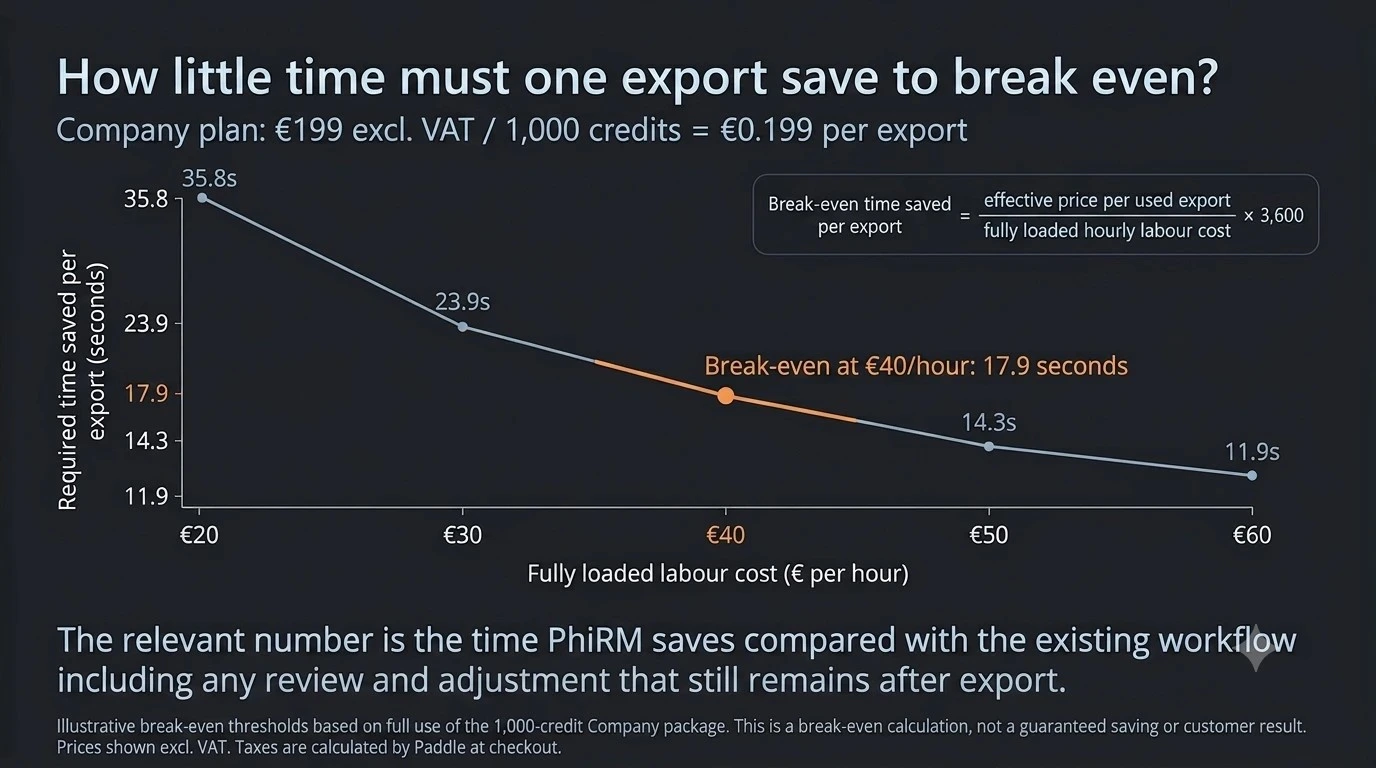
For example, if the manual workflow including final review takes 70 seconds and the PhiRM workflow including remaining review takes 45 seconds, the measured time difference is 25 seconds. At a fully loaded labour cost of 40 EUR per hour, a measured saving of 25 seconds is greater than the approximately 18-second break-even threshold for one fully used Company credit. This is an illustrative example, not customer data.
Business-cost table
| Cost source | What causes it | How to estimate it | Where PhiRM may help |
|---|---|---|---|
| Manual formatting | Headings, lists, spacing and presentation | Estimate minutes per document | May reduce repeated formatting work within supported output |
| Rebuilding document structure | Turning chat flow into usable sections | Estimate time spent reorganizing | Provides document-oriented reconstruction for supported conversations |
| Repeated exports | Same process across many chats or employees | Estimate monthly volume | Provides a repeatable DOCX/PDF workflow |
| Word preparation | Preparing output for editing or continued work | Estimate Word preparation time | Provides DOCX output for supported conversations |
| Review and sharing preparation | Checking and preparing the final file | Measure final review time | May reduce preparation, but does not eliminate review |
When the burden becomes meaningful
The burden becomes more meaningful when AI output is converted into documents frequently, conversations are long or structured, employees repeatedly produce reports or documentation, Word editing is required, or higher-cost professional time is spent on routine document preparation.
This is conditional. A person who exports one short answer occasionally may not need a workflow change. A team that repeatedly turns supported AI conversations into working documents has a stronger reason to measure the cost.
How PhiRM may reduce document-stage work
PhiRM is an AI-chat-to-document workflow for supported AI conversations. It is currently focused on supported ChatGPT and Gemini workflows and produces DOCX and PDF output for Word, review, sharing, printing and archiving.
Within supported workflows, PhiRM may help with document structure, headings, lists, tables, code, images and equations, depending on source content and supported features. PhiRM helps turn supported AI conversations into usable DOCX and PDF documents, which may reduce document preparation that would otherwise be performed manually.
What PhiRM does not eliminate
PhiRM does not eliminate factual review, professional judgement, source verification, final document approval or every formatting adjustment in every case. It is not a universal exporter for every AI platform and should not be treated as financial-analysis software.
The safest evaluation is to test representative supported conversations, measure the actual time difference and compare that measured value with current pricing.
Visual proof
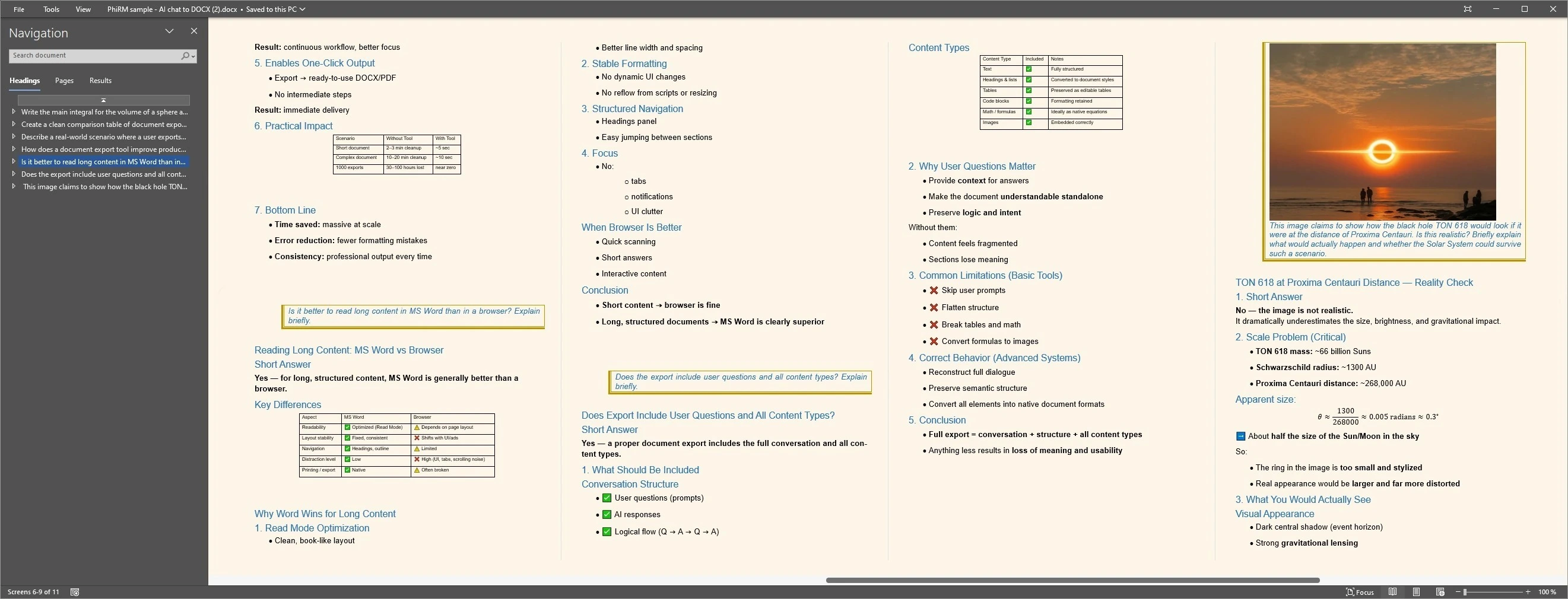
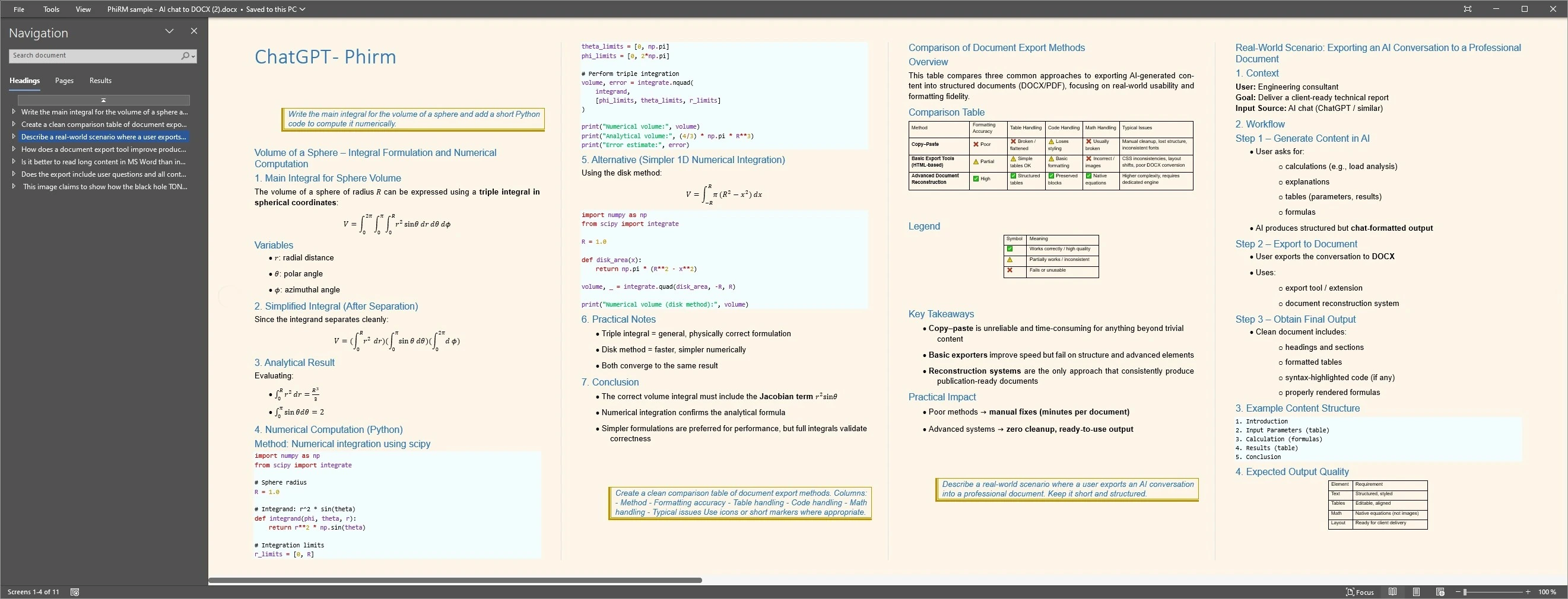
These examples show document output from supported AI conversation content. They help demonstrate usable DOCX structure and Word readability, not financial savings, customer outcomes or guaranteed cleanup reduction.
Output proof
FAQ
How do I calculate the productivity cost of cleaning AI output?
Use user-supplied inputs: the number of AI documents prepared each month, average manual cleanup minutes per document and fully loaded hourly labour cost. The formula is documents per month × cleanup minutes ÷ 60 × hourly cost. This estimates the current cleanup burden, not guaranteed savings.
What counts as AI document cleanup time?
Cleanup time can include copying AI output, rebuilding headings, repairing lists, adjusting tables, checking code blocks, placing images, handling equations, preparing Word output and reviewing the final file. Not every workflow includes every activity. The useful number is the cleanup time that actually happens in your own document workflow.
What is the difference between cleanup cost and ROI?
Cleanup cost is the current burden: the time and labour cost spent preparing AI output as documents today. ROI requires a measured reduction in that burden after using PhiRM, then subtracting the actual PhiRM cost. A large cleanup burden may create opportunity, but it is not automatically ROI.
Does PhiRM guarantee a specific ROI?
No. PhiRM does not guarantee a specific ROI, savings amount or productivity percentage. Value depends on workflow, volume, labour cost, source content, supported features and measured before-and-after cleanup time. The safest approach is to test representative supported conversations and compare real measurements with current pricing.
How should a company measure the productivity value of PhiRM?
Run a small before-and-after pilot with representative supported AI conversations. Measure cleanup and review time without PhiRM, then measure remaining review and adjustment time after exporting through PhiRM. Compare similar document types, use realistic volume assumptions and include final review consistently in both measurements.
Does PhiRM remove all manual document review?
No. PhiRM may reduce document preparation work within supported workflows, but factual review, source verification, professional judgement and final approval may still be required. AI-generated content should still be checked before professional use, especially when documents include important claims, tables, code, images, equations or external-facing material.
Measure the document stage of your AI workflow
Estimate your current cleanup burden, test PhiRM on representative supported conversations, and compare the measured time difference with current pricing.